
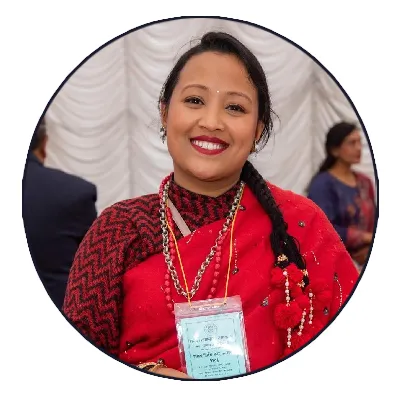
Speaker: Alina Tamrakar
(Independent Researcher)
This paper examines various initiatives of documentation of festivals, particularly the Yẽnyā
festival, which is one of the most vibrant festivals celebrated by Newa indigenous community of the Kathmandu valley. The yearly Yẽnyā festival, which continued amidst the earthquake-
stricken core settlement after the Gorkha earthquake-2015, in addition to the loss of life, historic monument and structures heavily damaged. While temples and monuments awaited their reconstruction, communities continued the rituals and festivals amidst the catastrophe.
According to local belief Yẽnyā was introduced during the reign of King Gunakamdev in
11th century. However, the first evidence of Indrajatra is in an inscription from 15th centuy. The
festival has been evolving throughout the time in the rule of simultaneous rulers who reigned in the valley. In recent years as well, many of the elements in relation to the festival have gone through alterations- big or small. These addition or deduction in the elements and details need to be documented to capture the changing cultural landscape of the city. The initial idea of this mapping of Yẽnyā festival can be elaborated in additional details about each of the elements of Yẽnyā festival and replicated for multiple other major festivals of Kathmandu Valley.
Documentation is a continuous process that should be done on timely intervals. Also,
there are various methods and perspective on which each type of documentation takes place. On individual levels and joint team levels, individuals from various sectors like documentarians, photographers, activists, students, heritage professionals are working to document and present the information about the festivals. The author’s involvement was in collection of information and present as a Yẽnyā mapping project. The project is free access and done under author’s own initiation, which has been circulated via social media and open access. The information presented in this Yẽnyā mapping project are simple yet from the respective community Guṭhī or members. The. In addition, the schedule list also includes name and details of respective Guṭhī members making it easier for anyone interested to further investigate deeper into the topic.
The growth of the content and expansion of its presentation in various space and media
has been truly inspiring and encouraging. In 2023, in addition to publication, Kathmandu
Metropolitan City also circulated the information of the Yẽnyā mapping that was incorporated in Galli maps- an app for city venture, which a new dimension in mapping and documentation of the festival. While adding details every year and sharing with wider audiences, the mapping project took larger form of documentation and presentation through the format of national and private organized exhibitions and publication.
This paper presents the experience of what started as a personal initiative to document the
Yẽnyā festival has now been acknowledged as a modern form of documentation in both digital and offline platforms have become a valuable resource for present and future generation.
Keywords: Yẽnyā, Documentation, tangible, intangible, Earthquake

Leave a Reply
You must be logged in to post a comment.