

The Past is a Foreign Country. Change and Continuity in Newah God-Making (1980 – 2025)
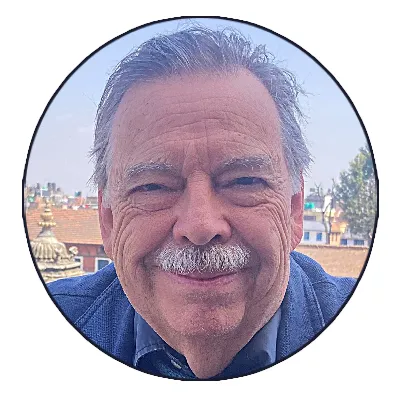
Speaker: Dr Tristram Riley-Smith
Sainsbury Research Unit,
University of East Anglia
T.Riley-Smith@uea.ac.uk
In 1979/80, I spent fifteen months conducting ethnographic research (as an anthropologist of art) among the Newah “god-makers” of Uku Bāhāḥ in the city of Patan.
I returned in February 2025 to explore what has changed after 45 years. I reconnected with old sources in the Uku Bāhāḥ community and established new ones, deriving insights from 25 contacts (and analysing over 500 statues for sale).
In this paper I will summarize key takeaways from this visit, including:
- changes to the role that caste plays in determining who fashions the gods;
- the changing market for new statues and the continuing role of consecrated images in Newah ritual life;
- the impact of technology on manufacturing and marketing bronze statues;
- the influence of Western notions of ‘art’, including an emerging ‘Cult of the Master’
- change and continuity in the portfolio of gods being made and sold around the world;
- attitudes of Shakya artists to the impact of these changes on themselves and their material culture.
This paper will cover many themes highlighted in this call, including the complex interaction of Newah religious practices, social divisions, economic activities, and traditional art following decades of socio-economic and technological change.
As the community of Uku Bāhāḥ is caught up in the reconstruction and maintenance of their tangible heritage, the issue of authenticity presents a major challenge. This conundrum is especially multi-faceted when applied to Newah art, with international and cross-cultural dimensions involving questions of Buddhist ritual and practice; traditional iconography and iconometry; artistic anonymity and identity; the hand-made and the mass-produced; branding and Intellectual Property Rights; and the autographic and the allographic.
This paper is the ethnographic equivalent of three-dimensional chess, not only drawing on the research of a British anthropologist working in Nepal in 1979-80 but also exploring the past – a “foreign country” in L.P. Hartley’s phrase – from the vantage point of 2025. It will demonstrate that heritage is a dynamic process, subject to economic, political and technological pressures and open to a multiplicity of overlapping, divergent and contested interpretations.
It touches on many of the topics that feature in the call, without being confined to any. These include the:
- heritage of Newah religious practices (including the preservation of Newah Buddhist ritual specialism and traditional knowledge, and the challenges of its preservation;
- Newah contributions to Nepali culture, especially around the branding of Nepali art;
- Politics of Heritage, with a focus on Shakya identity and the end of occupational orthodoxy.
See: Douglas, M. (1994) The Genuine Article in Riggins, S.H. (ed) “The Socialness of Things: Essays on the Socio-Semiotics of Objects” Berlin, New York: Mouton de Gruyter; Phillips, R. B. and Steiner, C.B. (1999) Art, Authenticity and the Baggage of Cultural Encounter in Phillips, R. B. and Steiner, C.B. (eds) “Unpacking Culture – Art and Commodity in Colonial and Postcolonial Worlds”, Berkeley: University of California Press.

Leave a Reply
You must be logged in to post a comment.